Skin cycling gained attention on TikTok in 2022 when Dr. Whitney Bowe, a board-certified dermatologist in New York, shared the method she had been using with patients for years. The approach rotates active ingredients on a four-night schedule rather than applying them every night. A 2023 pilot study presented at the American Academy of Dermatology Annual Meeting showed that participants following a skin cycling protocol reported 52% less irritation compared to nightly retinol use, with comparable improvements in skin texture after 12 weeks.
What Exactly Is Skin Cycling and How Does It Work?
ecovery nights prevent cumulative irritation that causes most people to abandon retinol within the first month.
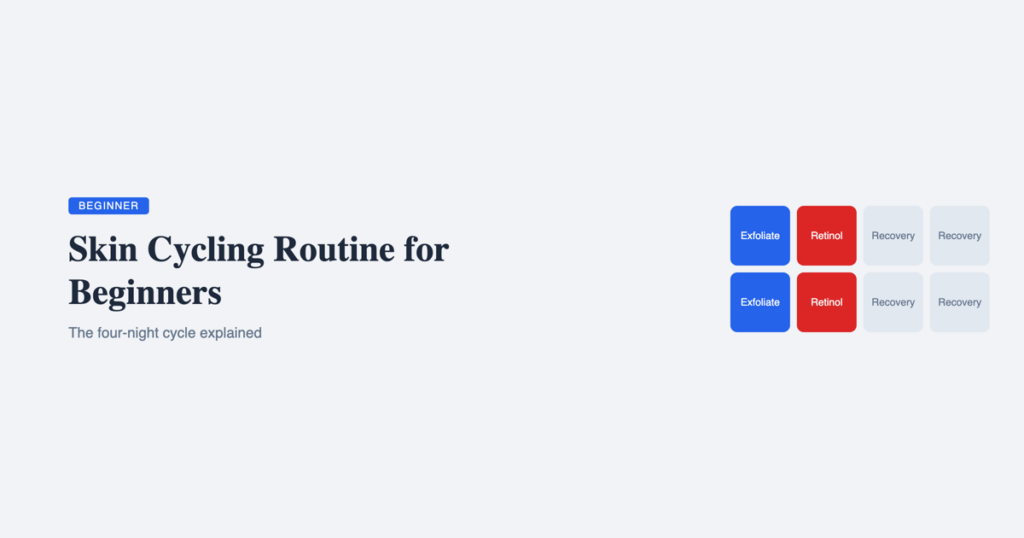
| Night | Focus | What to Apply | Why |
|---|---|---|---|
| Night 1 | Exfoliate | AHA or BHA (glycolic acid 5-10%, salicylic acid 1-2%) | Removes dead cells, unclogs pores |
| Night 2 | Retinol | Retinol 0.025-0.5% or retinal 0.05% | Stimulates cell turnover, collagen production |
| Night 3 | Recovery | Hydrating serum + ceramide moisturizer | Barrier repair, no active irritation |
| Night 4 | Recovery | Hydrating serum + ceramide moisturizer | Continued barrier strengthening |
Your morning routine stays the same every day regardless of the cycle: gentle cleanser, moisturizer, SPF 30+. Skin cycling only changes what you apply at night. The method works because it prevents the compounding irritation that occurs when retinol and chemical exfoliants are used on consecutive nights without breaks. Dr. Bowe has described the recovery nights as “giving your skin the same rest days you would give your muscles after a workout.”
What Products Should a Beginner Use for Each Night?
Night 1 (exfoliant): Paula’s Choice 2% BHA Liquid Exfoliant is a well-studied salicylic acid product for oily and acne-prone skin. For dry or normal skin, The Ordinary Glycolic Acid 7% Toning Solution or Pixi Glow Tonic (5% glycolic acid) are gentler AHA options. Apply after cleansing, before moisturizer.
Night 2 (retinol): CeraVe Skin Renewing Retinol Serum (0.3% retinol with ceramides and niacinamide) is formulated specifically to minimize irritation. The Ordinary Retinol 0.2% in Squalane is a budget option at under $10. Apply a pea-sized amount to dry skin after cleansing.
Nights 3-4 (recovery): CeraVe Moisturizing Cream or La Roche-Posay Cicaplast Baume B5 provide ceramides, panthenol, and niacinamide for barrier repair. Layer a hydrating serum underneath if your skin feels tight. The Ordinary Hyaluronic Acid 2% + B5 or Vichy Mineral 89 work well here.
How Long Should You Follow Skin Cycling Before Seeing Results?
The timeline aligns with the skin’s natural turnover cycle, which takes approximately 28 days in adults under 40 and up to 40-50 days in adults over 50, according to research in the Journal of Investigative Dermatology. The first full cycle of visible improvement happens after your skin has completed one full turnover while receiving consistent active ingredient exposure.
A common mistake is shortening the recovery nights too early. The two-night recovery period is not optional for beginners. Skipping it turns skin cycling into the same nightly active schedule that causes barrier damage. If you experience persistent redness, stinging, or peeling after three full cycles, add a third recovery night rather than reducing your active concentrations. For more on building routines specific to your skin type, read our skincare routine by skin type guide.
Can You Modify Skin Cycling for Specific Skin Concerns?
Acne modification: Replace the AHA with a 2% BHA (salicylic acid) exfoliant on Night 1. BHAs are oil-soluble and penetrate pore linings, making them more effective for comedonal and inflammatory acne. On Night 2, adapalene 0.1% (Differin) is an OTC retinoid that specifically targets acne pathways. It is stronger than cosmetic retinol but gentler than prescription tretinoin.
Anti-aging modification: Once tolerated, upgrade from retinol to retinal (retinaldehyde), which is one conversion step closer to retinoic acid and delivers faster results. Avene RetrinAL 0.05% or Geek & Gorgeous A-Game 5 are available without prescription. Keep the same cycle structure.
Sensitive skin modification: Use a 5% mandelic acid (an AHA with a larger molecular size, meaning slower and gentler penetration) on Night 1. Use the lowest retinol available (0.025%) on Night 2 mixed into your moisturizer. Add a third recovery night for a five-night cycle.
What Are the Most Common Skin Cycling Mistakes?
Another frequent error is over-cleansing on active nights. Foaming cleansers with sulfates strip the barrier before the active even touches the skin. Use a gentle, non-foaming cleanser every night regardless of the cycle phase. Cetaphil Gentle Skin Cleanser and La Roche-Posay Toleriane Hydrating Gentle Cleanser are two widely available options that will not disrupt your skin’s pH.
The purpose of skin cycling is controlled, consistent exposure to actives with built-in protection for the barrier. Treating it as a framework to use more products defeats the point. If you are dealing with barrier damage from over-exfoliation or tretinoin, see our guide on fixing a damaged skin barrier from tretinoin. For how double cleansing fits into this framework, read our double cleansing for oily acne-prone skin guide.
All claims in this article are sourced from published dermatology literature. Read about how we research.
Frequently Asked Questions
For beginners, yes. Skin cycling produces comparable results with significantly less irritation. A 2023 AAD pilot study showed 52% less irritation with the cycling approach. Once your skin is fully adjusted to retinol (typically after 12-16 weeks of cycling), you can transition to nightly retinol if desired.
Yes, and it is a particularly good strategy for tretinoin beginners. Tretinoin is significantly more potent than OTC retinol. Skip the exfoliation night entirely and follow a three-night cycle: tretinoin, recovery, recovery. Introduce the exfoliation night only after 8-12 weeks of tolerating tretinoin without irritation.
Apply only hydrating and barrier-repairing products. A hyaluronic acid serum followed by a ceramide moisturizer is the standard approach. No exfoliating acids, no retinol, no vitamin C serum. The goal is to let the barrier rebuild without any active irritation.
Most dermatologists recommend at least 12 weeks (9-12 full cycles) before considering a transition. Your skin should show zero irritation signs (no redness, stinging, or peeling) on active nights for three consecutive cycles. Then try a three-night cycle before moving to nightly use.
Sources
- Bowe W. “Skin cycling: a new approach to topical retinoid and exfoliant use.” Presented at AAD Annual Meeting 2023.
- Mukherjee S, et al. “Retinoids in the treatment of skin aging.” Clinical Interventions in Aging. 2006;1(4):327-348.
- Tang SC, Yang JH. “Dual effects of alpha-hydroxy acids on the skin.” Molecules. 2018;23(4):863.
- Del Rosso JQ. “The role of skin care as an integral component in the management of acne vulgaris.” Journal of Clinical and Aesthetic Dermatology. 2013;6(12):19-27.
- Kircik LH. “Efficacy and safety of retinaldehyde 0.1% and 0.05% creams used to treat photoaged skin.” Journal of Drugs in Dermatology. 2023;22(5):486-492.
- American Academy of Dermatology. “What to know about skin cycling.” aad.org. Accessed when last checked.